Browser strategy game · 1900–1940
Admiralty
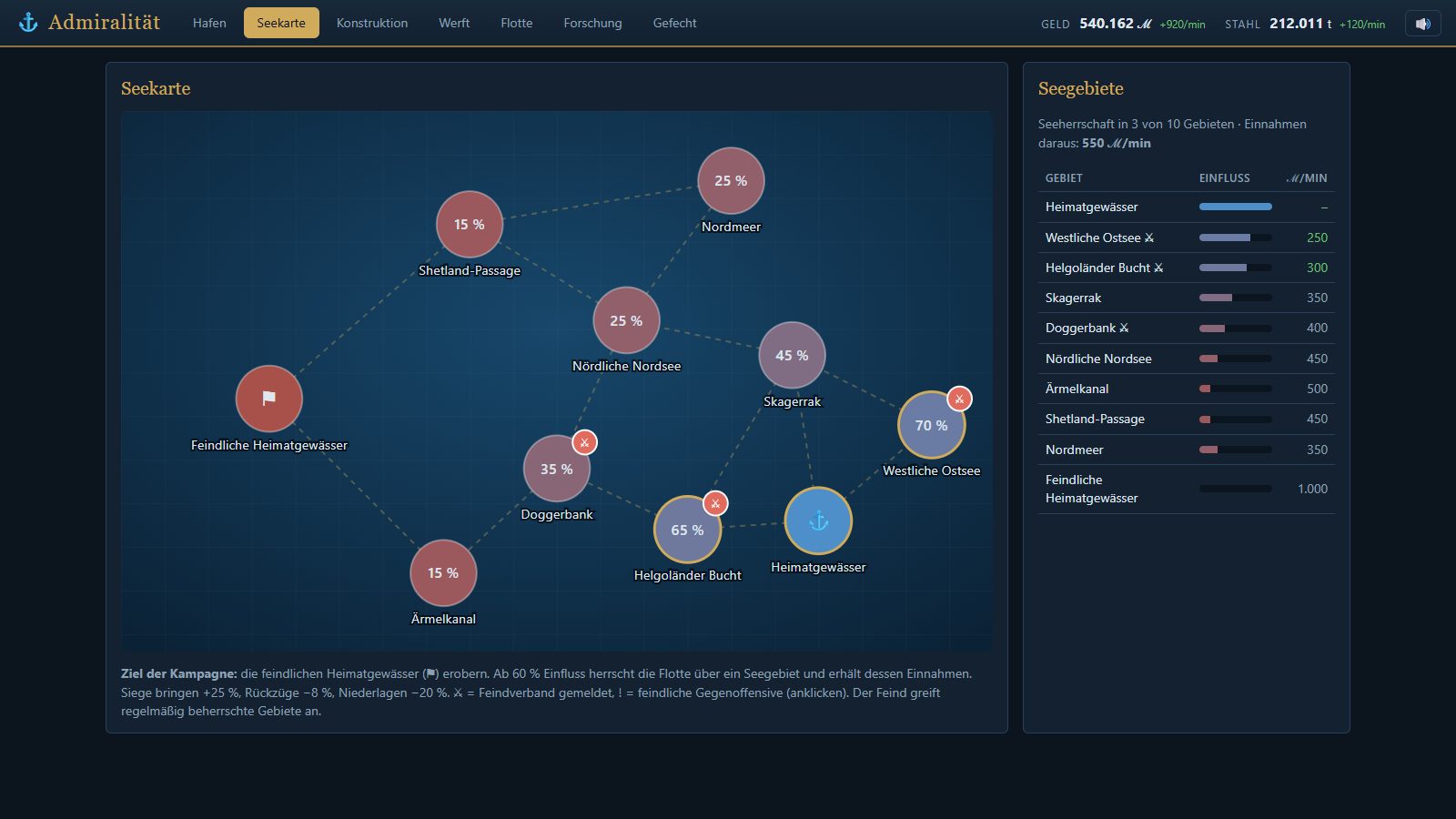
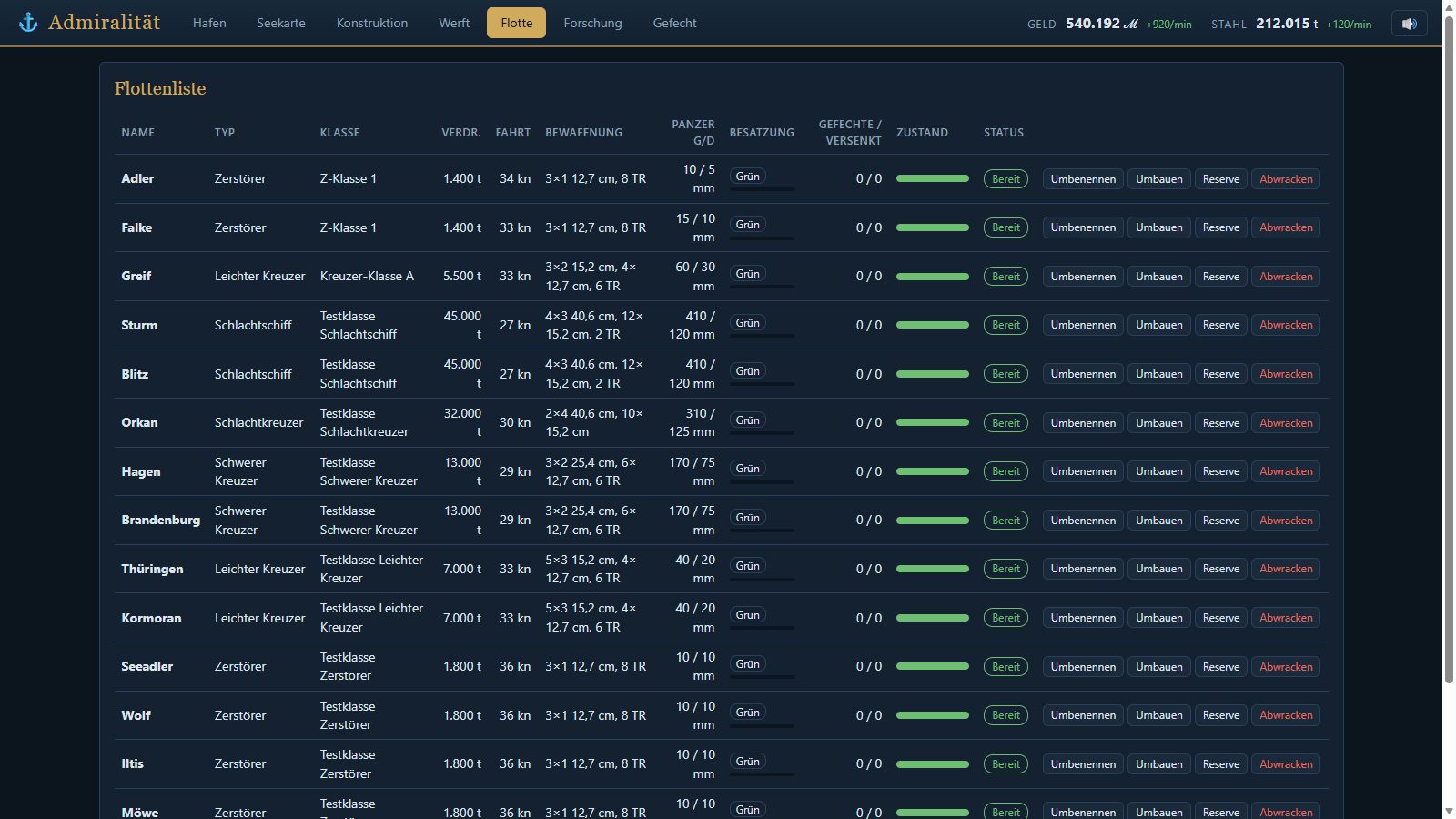
Design your own battleships – displacement, speed, calibre, turrets and armour – build them in your shipyard and command them in naval battles with real ballistics. On the sea chart you fight for command of the sea, research better technology and repel enemy counter-offensives.
Free · no name, e-mail or password · on any device
How to play
- 1
Design
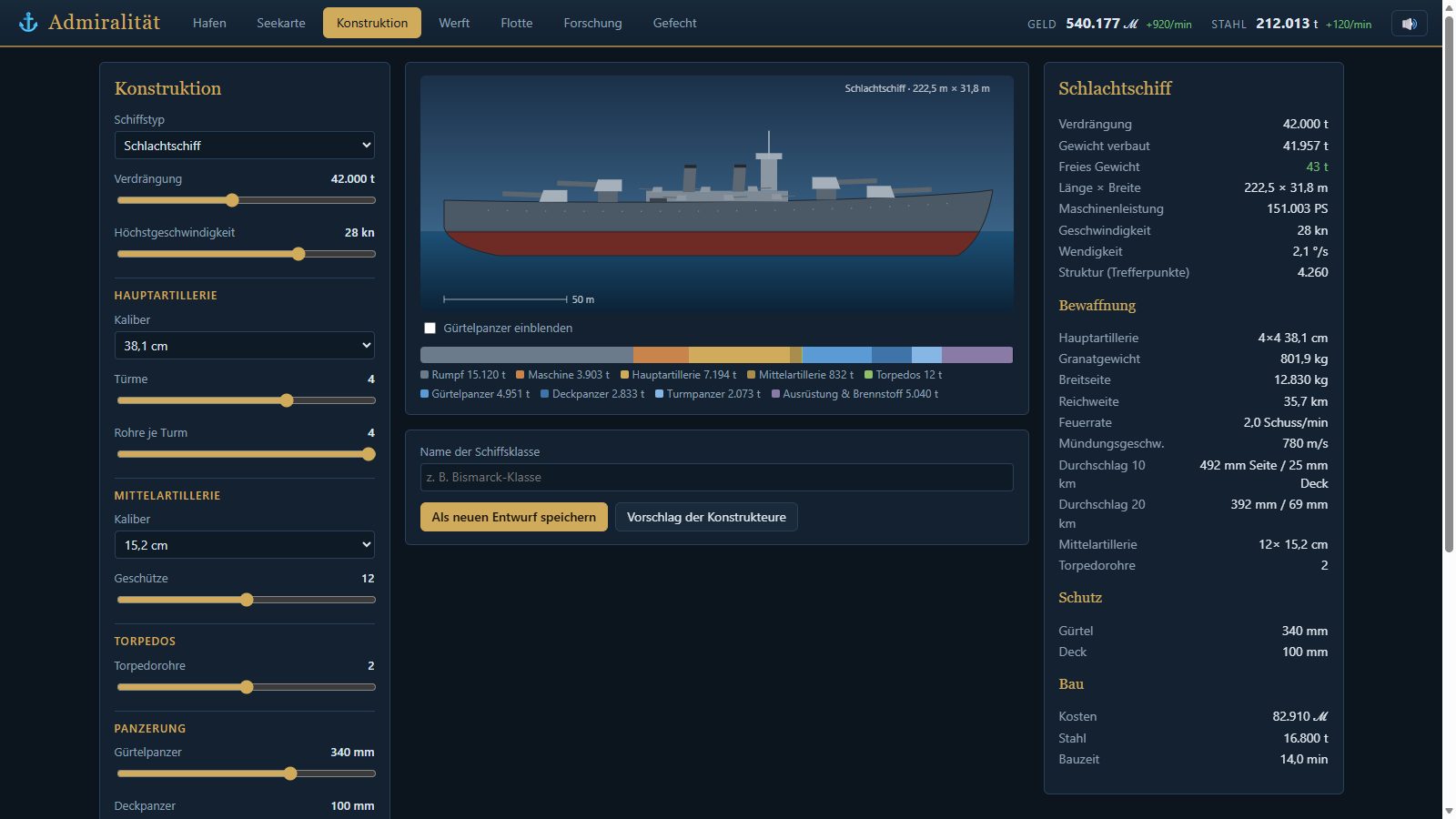
In the design office you choose hull, displacement, speed, guns, torpedoes and armour. Every ton counts: what goes into the engines is missing from the armour.
- 2
Build
The shipyard builds from money and steel – a destroyer in just over an hour, a battleship in more than a day. You expand steelworks, shipyard, docks and naval school step by step.
- 3
Put to sea
On the sea chart you pick missions: conquer sea areas, protect or intercept convoys, cover landings on enemy coasts, repel counter-offensives. Then choose ships, admiral and deployment.
- 4
Fight
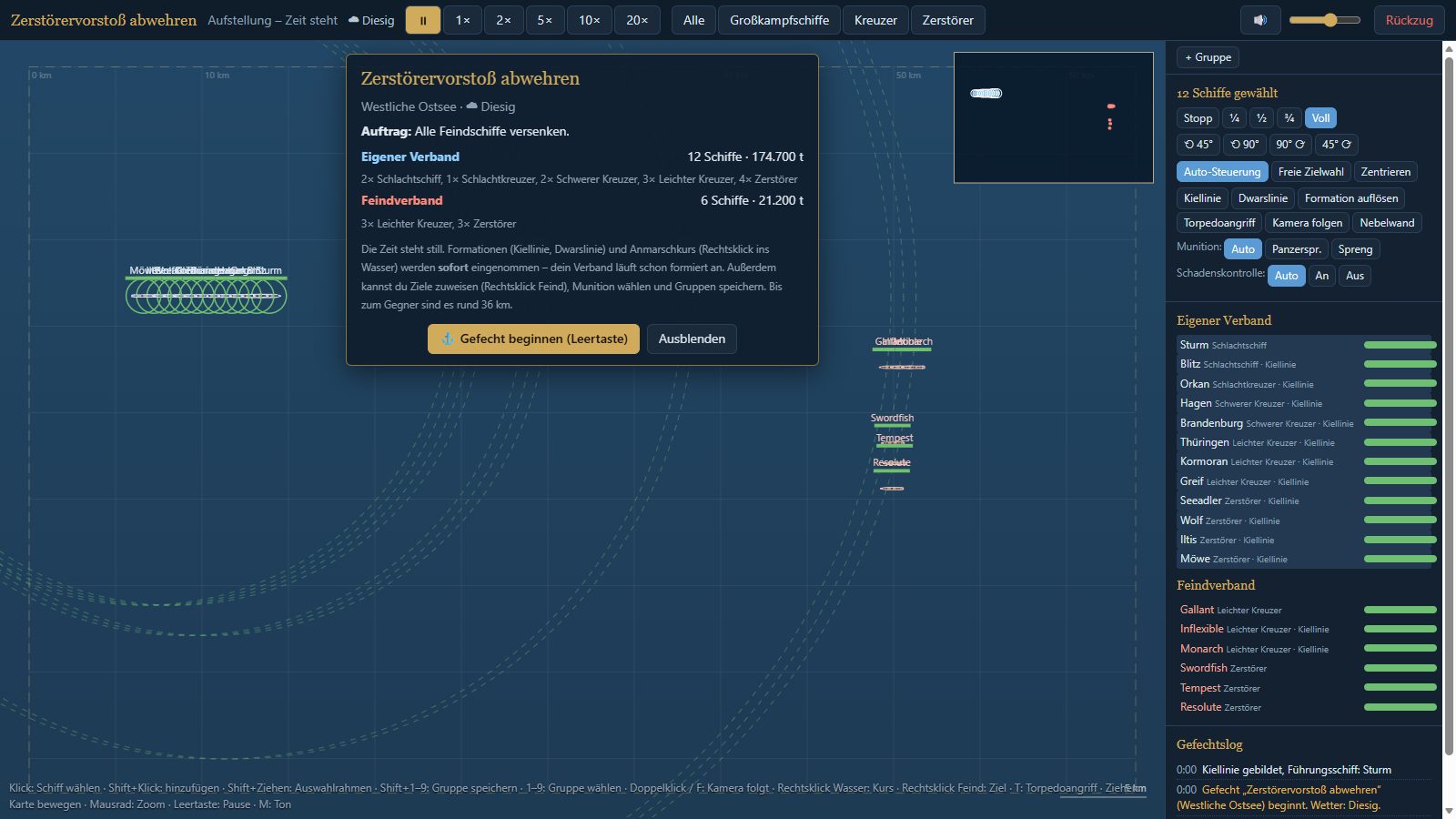
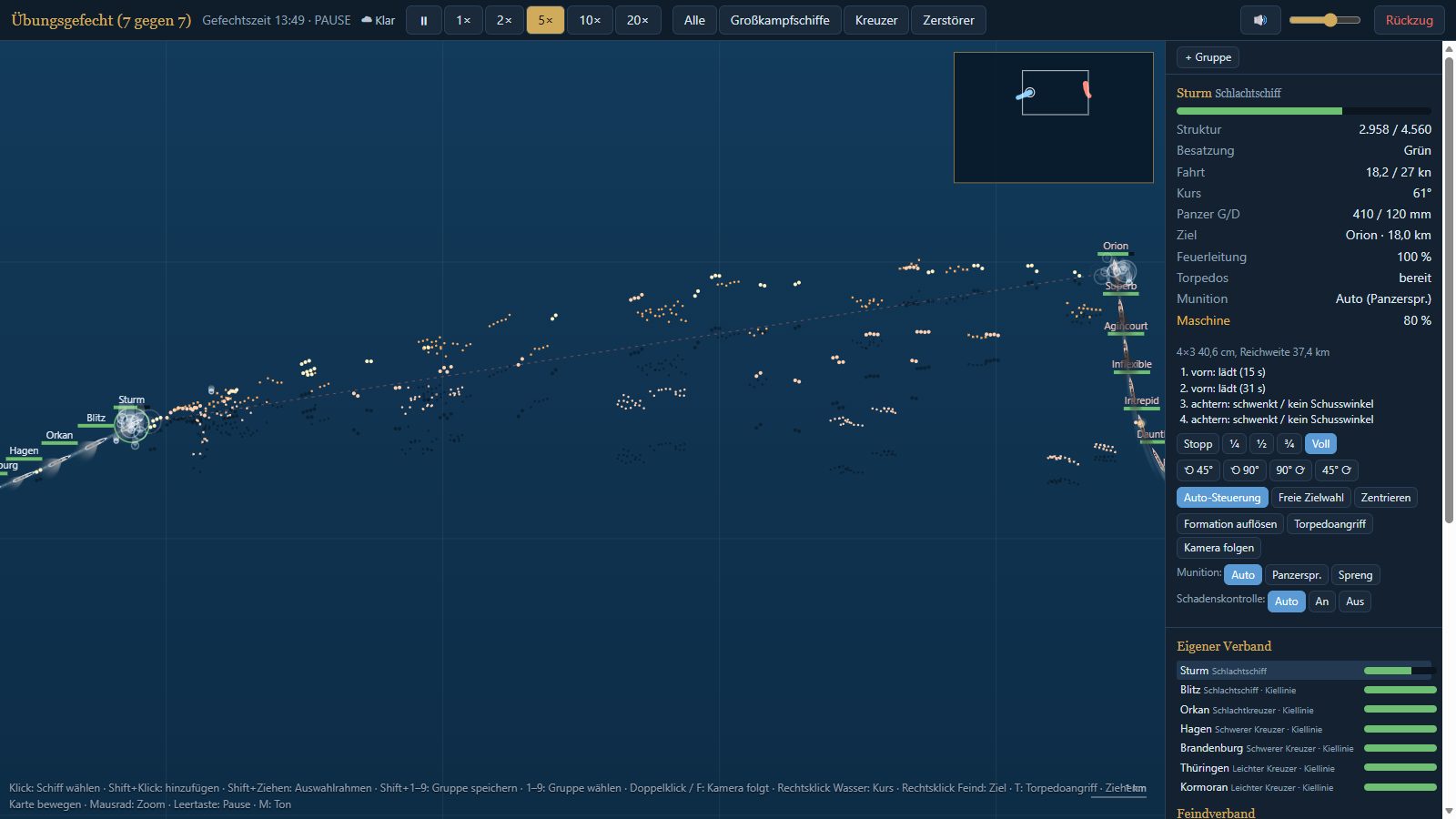
You command the battle yourself: course, formation, targets, fire discipline, smoke and torpedoes. Victories bring prize money, steel and prestige – which unlock larger ships and calibres.
Impressions
Ship types
Five hull types, each with its own size range and limits. The profiles are sample designs from the design office, with the armour belt shown.
Destroyer
Fast and cheap. With torpedoes a threat to any capital ship, but barely armoured.
- Displacement
- 600–2,800 t
- Speed
- 26–40 kn
- Calibre
- up to 15.2 cm
- Belt
- up to 25 mm
- Torpedoes
- up to 16
Example: 1,600 t · 34 kn · 3 guns 12.7 cm · Belt 15 mm
Light cruiser
Scout and destroyer hunter with quick-firing guns.
- Displacement
- 2,500–11,000 t
- Speed
- 24–37 kn
- Calibre
- up to 15.2 cm
- Belt
- up to 120 mm
- Torpedoes
- up to 12
Example: 6,300 t · 32 kn · 12 guns 15.2 cm · Belt 50 mm
Heavy cruiser
The powerful all-rounder for convoy escort and commerce raiding.
- Displacement
- 7,000–20,000 t
- Speed
- 24–35 kn
- Calibre
- up to 25.4 cm
- Belt
- up to 200 mm
- Torpedoes
- up to 12
Example: 12,900 t · 31 kn · 12 guns 20.3 cm · Belt 135 mm
Battlecruiser
Battleship calibre at high speed – paid for with thinner armour.
- Displacement
- 16,000–50,000 t
- Speed
- 25–34 kn
- Calibre
- up to 40.6 cm
- Belt
- up to 350 mm
- Torpedoes
- up to 8
Example: 31,300 t · 30 kn · 12 guns 38.1 cm · Belt 245 mm
Battleship
The heaviest guns and the thickest armour: the backbone of every fleet.
- Displacement
- 16,000–75,000 t
- Speed
- 18–32 kn
- Calibre
- up to 46.0 cm
- Belt
- up to 500 mm
- Torpedoes
- up to 4
Example: 48,500 t · 26 kn · 12 guns 38.1 cm · Belt 495 mm
Six nations
Every navy has one strength and one weakness and fights in its own theatre against its historical rival.
Imperial German Navy
GermanyTheatre: North Sea · Rival: Great Britain
+ Krupp armour steel: +8 % armour protection
− Smaller shipbuilding industry: construction takes 10 % longer
Royal Navy
Great BritainTheatre: North Sea · Rival: Germany
+ World's largest shipbuilding industry: construction 15 % faster
− Unsafe magazines: magazine explosions 50 % more likely
United States Navy
USATheatre: Pacific · Rival: Japan
+ Largest economy: state budget +15 %
− Little practice in poor visibility: −10 % visual range
Imperial Japanese Navy
JapanTheatre: Pacific · Rival: USA
+ Long Lance torpedoes: +20 % torpedo range and effect
− Small economy: state budget −5 %
Marine nationale
FranceTheatre: Mediterranean · Rival: Italy
+ Quick-firing guns: reload time −8 %
− Outdated fire control: −5 % accuracy
Regia Marina
ItalyTheatre: Mediterranean · Rival: France
+ Precise Ansaldo guns: +8 % accuracy
− Light armour in favour of speed: −5 % protection
Battle tips
You can leave any battle to the auto-helm or take over at any time – even mixed, ship by ship. Press the space bar to pause and give orders at leisure.
Automatic
What the auto-helm does by itself:
- keeps the broadside towards the enemy so that all turrets bear
- seeks the range at which its own shells penetrate the enemy belt
- destroyers zigzag in for a torpedo attack and then turn away
- damaged destroyers and cruisers lay smoke and withdraw
- shell type and damage control are set to “auto”
Good for getting started, for destroyers and when you clearly outgun the enemy. But: every ship fights on its own – the squadron spreads out, and the auto-helm never crosses the T.
Command yourself
Where you gain the edge:
- line ahead: the ships follow the largest one and the squadron stays together
- “cross the T” already at deployment: across the enemy line, all your turrets against their forward ones
- concentrate fire: right-click (or long-press) an enemy – all selected ships fire at it
- launch torpedo attacks deliberately (key T) while the enemy holds course
- take damaged ships out of the line in time
- at night: searchlights (L) and star shells (G) – but light gives you away
Worth it in even or unfavourable battles and whenever battleships are involved.
Our advice: mix both
- At deployment, put the big ships in line ahead and choose “cross the T”.
- Leave destroyers on the auto-helm – they handle torpedo attacks and smoke well on their own.
- Concentrate the fire of your line on the most dangerous ship in range. A sunk ship no longer fires back, two half-damaged ones still do.
- Keep fire discipline on “effective”: it saves about a third of your shells. Ammunition is limited and costs money.
- Armour beats speed only if you can close in – a faster enemy decides the range.
- For landings, secure the sea first: the transports wait until the enemy squadron is beaten. Do not send them in while the coastal batteries are still firing – or you risk a Gallipoli.
- If things go badly, order the retreat in time: it costs less influence than a defeat (−8 % instead of −20 %). The shipyard repairs damaged ships, sunk ones are lost.
Controls: click selects a ship, right-click on the water sets the course, right-click on an enemy sets the target, space pauses. On phones: tap, long-press, pinch to zoom.
What else awaits you
Design office
Design ships from destroyer to battleship yourself, with weight and cost calculation.
Naval battles
Shells with trajectory and dispersion, belt and deck armour, fires, flooding, torpedoes, smoke screens, mines and coastal batteries – and limited ammunition with fire discipline.
Tactics
Line ahead, line abreast and the classic manoeuvre “crossing the T”: across the head of the enemy line so that all your turrets bear.
Three theatres, six nations
North Sea, Pacific and Mediterranean – Germany, Great Britain, USA, Japan, France and Italy, each with its own strengths and weaknesses.
Night actions
Searchlights and star shells; gun flashes give your position away.
Admiralty staff
Admirals with biography and service record rise from commodore to admiral of the fleet.
Eras
From 1900 through the Great War and the naval treaties to the super-battleships.
The long game
Shipyard, economy and research carry on while you are offline – larger ships are unlocked over weeks.
Your account
To play, you create a free account. You need no name, e-mail or password: you receive an access code to sign in on any device. Your game is saved automatically after every action. Keep the code safe – without it there is no access.
Runs on computers as well as phones and tablets (best in landscape).